

By Maggie Aherne, Archive Volunteer
Smyth? Who is this? We all know who designed Clifton Suspension Bridge: originally, Isambard Kingdom Brunel in the 1830s, whose design was modified and strengthened by John Hawkshaw and William Henry Barlow in the 1860s when the bridge was finally completed. So who is Smyth, and what role did he play in the design of the bridge?
More than one member of the Smyth family – owners of the nearby Ashton Court estate – was involved in the history of the bridge, starting with Sir John in the 1830s. He owned the land that the company had to purchase in order to link the bridge with the main road to Portishead (now the A369). Those goings-on are a whole other story! The Smyth who interests us here is his great-nephew, Sir Greville, who was instrumental in the second phase of construction, the 1860s.
Sir Greville had inherited Ashton Court in 1852 at the tender age of 16, and the family solicitor and steward of Ashton Court, Arthur Way, had acted as his guardian until the young Smyth came of age. (For information on the Way family at this time, see https://ahousehistory.com/the-way-era-1880-1936/.) Unsurprisingly, Smyth was wealthy: with an annual income of £27,000, he was among the richest men in Somerset. He had a great interest in natural history and spent much time collecting birds’ eggs and other specimens, eventually having a private museum built to contain his collection. This building no longer exists, but some of his collection – including two eggs from the now extinct great auk – is kept at the Bristol Museum and Art Gallery.
Sir Greville’s love of nature did not extend to conservation, sadly: he spent much of his spare time hunting. Not just foxes or hares, but much bigger prey. The Bristol Times & Mirror of 27 October 1860 reported his shooting five stags and a roebuck at Inverness, three of the stags on the same day. Further afield, a newspaper report from 18 August 1860 describes ‘Sir Greville Smyth’s Sport in the Far-West’ where an English hunting party including Sir Greville had been ‘very successful’: ‘Among their trophies are buffalo hides and heads, elk, four magnificent American eagles, etc. … The gentlemen composing the party are so well pleased with their trip that they propose to repeat it at very no distant day.’ Please, gentlemen, don’t!
This information about Sir Greville’s lifestyle is actually relevant to the bridge, as becomes clear from some entries in the letterbooks of Osborne Ward & Co., the company’s solicitors (accessible at Bristol Archives, catalogue 12167/44). It had been broadcast in the news (for example, a Western Daily Press report of 3 August 1861) that Sir Greville had promised a ‘free gift’ of £5000 to assist the bridge’s finances: at this point it’s important to remember that the first phase of the undertaking had stuttered to a halt through lack of funds (again, a whole other story of great interest). Having wealthy supporters such as Sir Greville was hugely important to the Directors.
However, this £5000 was not in fact a free gift – there were strings attached. In September 1860 Osborne Ward’s clerk wrote to John Miles of the adjacent Leigh Court estate, whose late father Sir Philip had at one time been the Treasurer of the bridge company, inviting him to a meeting with the Directors and Arthur Way, representing Sir Greville. This meeting was ‘to decide what terms can be arranged, which will be mutually satisfactory with Sir Greville Smyth who it is understood will not give any portion of the £5000’ (emphasis in original). An agreement was reached in October, as the clerk writes to William Henry Barlow: ‘We have the pleasure of sending you a Copy of Mr Arthur Way’s letter assenting on Sir Greville Smyth’s behalf to the proposal for taking £2500 in shares & giving £2500 down as a free gift on the day of the opening of the Bridge.’
So what were the ‘strings attached’? One was that Sir Greville was asking for exemption from tolls for Ashton Court’s horses and carriages. The clerk wrote on 24 October to Captain Claxton, the company secretary: ‘As regards the exemption you will observe that we contemplate proposing a personal exemption to Sir Greville & his Carriages & Horses and not any exemption attached to the Court for 50 years. The latter is not only impracticable but excessive […] The Toll exemption does not extend to Agricultural Carts & Carriages unless indeed Sir Greville should paint his Arms upon them & put his laborers into Livery. If this should be deemed likely we had better insert an express reservation. The exemption also does not extend to Sir Greville’s horses or Carriages ridden by his friends unless accompanied by a livery Servant.’
The request for an exemption for 50 years (we will return to the subject of carts) prompted this letter on 12 November 1860 from Osborne Ward’s solicitor to Captain Huish, the company chairman: ‘I have to day had an interview with Sir Greville Smyth’s Solicitor, and I find that Mr Way adheres not only to the Exemption of Carts, which I do not think of much moment, but he also holds out for the full term of 50 years, which seems to me of more importance. True, at Sir Greville’s age (24) he might live 50 years, but with the adventurous sort of life he leads, it is more likely that he should not live five. And if he dies within 50 years Mr Way would make the Exemption extend to his Successors in the Estate whereas I think it ought to terminate with his life. […] At present Sir Greville is in the Neighbourhood & could sign the Agreement & Subscription Contract. In a few days he is going to the Himalayas to shoot tigers & such small [? beer] and it seems to me of great Consequence to obtain his own signature to both documents before he goes.’
We will note at this point that Sir Greville did not in fact live 50 years beyond the bridge’s opening: he died in 1901, some 37 years after the bridge opened. But at least he lived longer than the five years projected for him by the solicitor! When the agreement between Sir Greville and the Directors was finally signed, the toll exemption period had been reduced to 30 years.
Getting back to the carts: remember that the suggested agreement was for an exemption from tolls for Sir Greville’s own horses and carriages only, to exclude agricultural vehicles. This proved to be a sticking point, as can be seen in a letter of 6 November 1860 from Osborne Ward to Arthur Wansey, solicitor for Sir Greville: ‘we send for your perusal on behalf of Sir Greville Smyth the Draft of a proposed Agreement between that Gentleman and the promoters of the Suspension Bridge. […] you will see that Mr Way has given a general approval to the Agreement, and that the only point on which any difference suggests itself is as to the exemption from toll extending to Carts as well as Carriages. This is too minute a question to cause any real difference between Sir Greville and the promoters, and if he makes a point of it, we should advise its being conceded. But the matter was before the Board on Thursday last and they expressed a strong opinion that Sir Greville ought not to require it, and we trust he will waive it. It would be of little real value we conceive to Sir Greville while Carts are not the class of Vehicle it seems desirable to introduce into Clifton.’ Quite.
Eventually, the Directors reluctantly agreed to Way’s terms. There is one rather sweet note in a letter to Way of 16 October 1860, on the need to be clear about who was exempt – Sir Greville only, and not all and sundry who might call on him: ‘I cannot anticipate any difficulty as to the free Ticket to Ashton Court except that the Company for the sake of Sir Greville if not for their own sake also must take care that he is not inundated with visits from all the Bristol Citizens at Ashton Court passing over the Bridge free.’
But to return to our original question: what influence did Sir Greville have on the construction of the Suspension Bridge? The ‘strings attached’ to his financial support were exemption from tolls and the width of the roadway. On 19 October 1860 Osborne Ward’s clerk wrote to the company’s legal representative who was steering the requisite Bill through Parliament, presuming that ‘the Bill will not prescribe the width of the Bridge so that the Agreement with Sir G Smith [sic] may be contingent upon the Bridge being proceeded with & completed either as a Bridge of 30 Feet or any [? less] width’. Writing to Captain Claxton on 24 October, ‘we now forward the draft of an Agreement with Sir Greville Smyth for the perusal of Captn Huish & Mr Hawkshaw or Mr Barlow and shall be obliged by their observations thereon. We had in the first instance prepared it so as to leave it still open to the Committee, or to the Company when incorporated, to adopt either the 24 or 30 foot Bridge […] Mr Barlow will please to consider whether the width of the Bridge is correctly defined’.
Why did this matter? More detail is provided in local historian Derek Portman’s ‘A Business History of the Clifton Suspension Bridge’ (Construction History Vol. 18, 2002), which points out Sir Greville’s desire to sell part of the Ashton Court estate for development. The success of such a plan would require good connections between Ashton Court, on the one hand, and Clifton and Bristol on the other. The original proposal for the bridge was that it would be 24 feet wide: a 16-foot wide roadway, bordered on each side by a 4-foot wide footway. This was too narrow for vehicles travelling at speed in opposite directions to pass each other. Smyth’s purchase of shares to the value of £2500 plus the gift of the same amount on opening day would pay for the roadway to be widened from 16 to 22 feet.
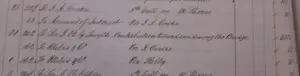
The company cash book showing Sir Greville’s payment of £2,500 towards widening the bridge
Portman also points out that it was the advent of motor vehicles that brought the bridge to life as a commercial construction rather than merely a leisure one. Toll income rose over the decades along with the rise in car ownership, and the bridge began to meet a commercial as well as a leisure need. This would have been stifled had the bridge been built to its original plan, as Portman concludes: ‘The long term viability of the structure was secured by Greville Smyth’s insistence that the bridge was widened to permit carriages and by extension, cars to pass each other at speed.’
Today, the 3-million-plus motorists who use the bridge annually, safely and smoothly, have not only Brunel and Hawkshaw & Barlow, but also Sir Greville, to thank.